AUGUST 19

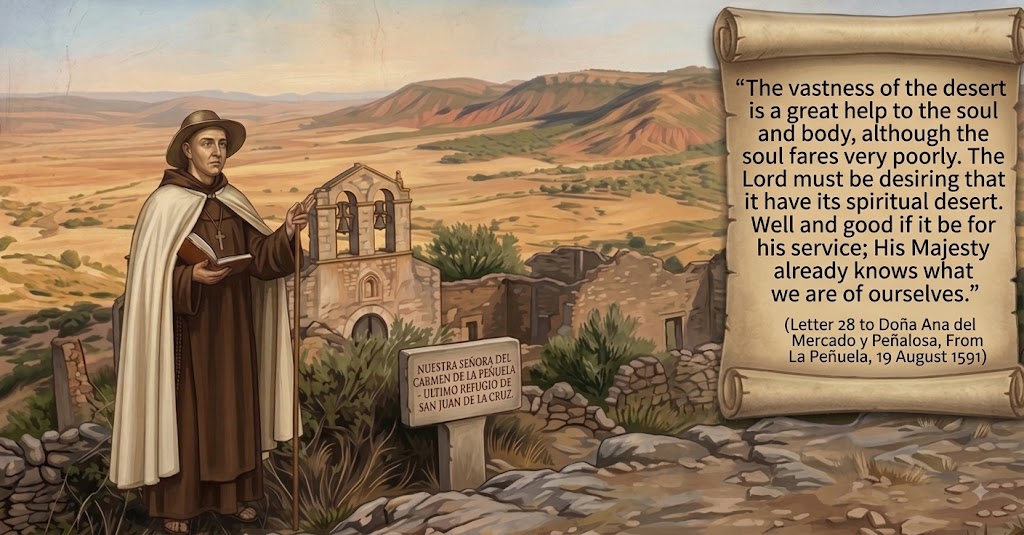
On 10 August 1591 – Saint John of the Cross transferred from the friars’ convent in Segovia to the solitude of La Peñuela, where at last he was relieved of all offices in the order; once again he was a humble friar, forgotten, despised, and neglected… as he had always desired.

His superior was the Provincial, Father Antonio de Jesús, with whom he had begun the reform under the guidance of Saint Teresa many years earlier in their humble abode in Duruelo.

Although John was able to pray gloriously in the solitude of rocks and forest, difficulties lay ahead; within weeks he would develop erysipelas, a skin infection on his foot that would lead to septicemia. By December, consumed by penances, trials, and his disease, Saint John of the Cross would die and go to “sing Matins in heaven.”

St. John of the Cross writes from La Peñuela about finding peace in solitude after being relieved of all offices. He delights in simple monastic work and the silence of harvesting chickpeas over worldly complications, asking prayers to remain in this blessed desert retreat.
 

“Faith,” St. Paul says, “is the substance of things to be hoped for, the evidence of things not seen” [Heb 11:1].

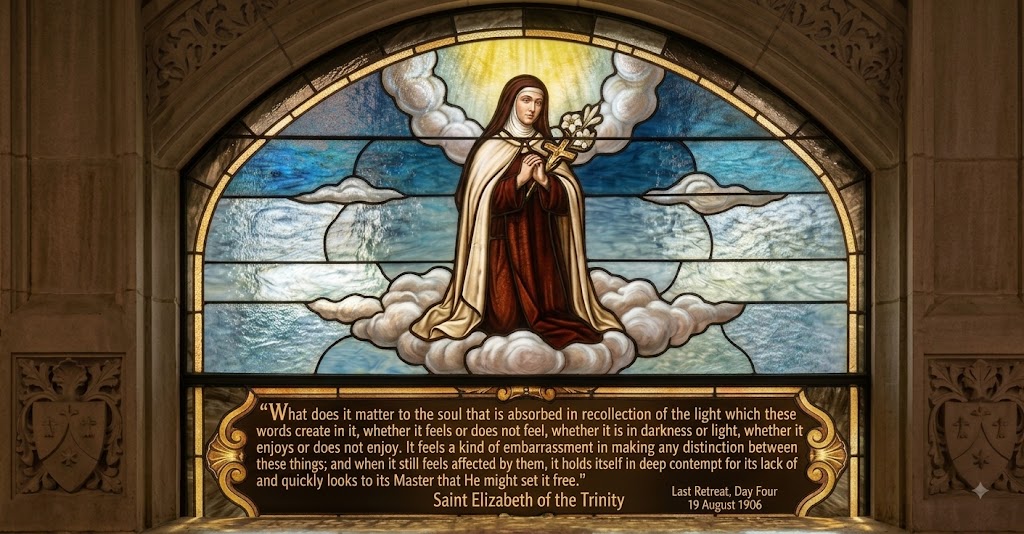
What does it matter to the soul that is absorbed in recollection of the light which these words create in it, whether it feels or does not feel, whether it is in darkness or light, whether it enjoys or does not enjoy. It feels a kind of embarrassment in making any distinction between these things; and when it still feels affected by them, it holds itself in deep contempt for its lack of love and quickly looks to its Master that He might set it free. In the expression of a great mystic it “exalts” Him “on the highest summit of the mountain of its heart, above the sweetness and consolations that descend from Him for it has resolved to go beyond everything to be united with Him whom it loves” [Ruysbroeck]. It seems to me that to this soul, unshakable in its faith in the God of Love, may be addressed these words of the Prince of Apostles, “Because you believe you will be filled with an unshakable and glorified joy” [1 Pt 1:8].

Saint Elizabeth of the Trinity

Last Retreat, Day Four
Sunday, 19 August 1906
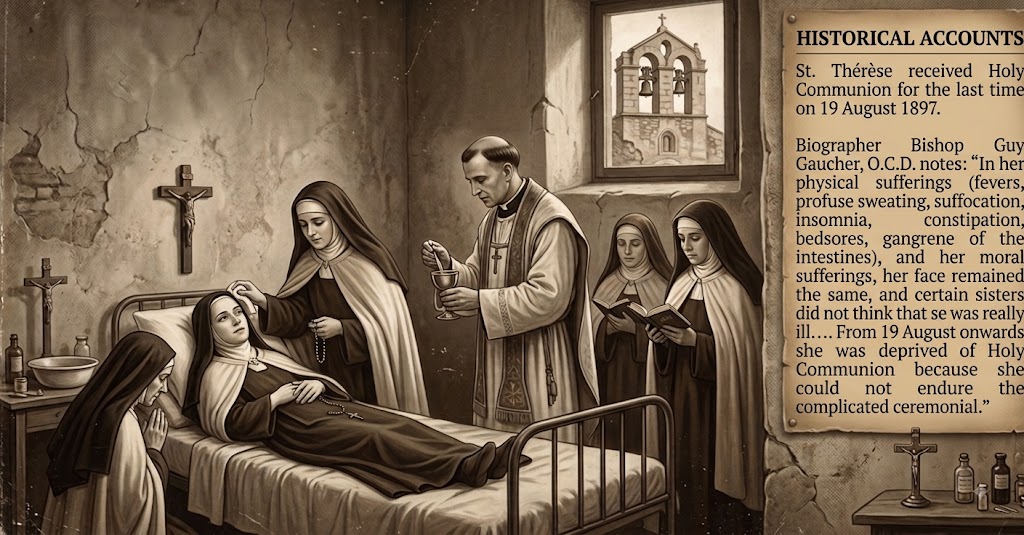
 

She must have felt bad before Holy Communion when hearing the Sisters reciting the Miserere in a low tone of voice. She told me afterwards, shedding huge tears:

“I’m perhaps losing my wits. Oh! If they only knew the weakness I’m experiencing.

“Last night, I couldn’t take anymore; I begged the Blessed Virgin to hold my head in her hands so that I could take my sufferings.”

Saint Thérèse of Lisieux

Yellow Notebook, 19 August 1897

Note: St. Thérèse received Holy Communion for the last time on 19 August 1897.

Biographer Bishop Guy Gaucher, O.C.D. notes:

In her physical sufferings (fevers, profuse sweating, suffocation, insomnia, constipation, bedsores, gangrene of the intestines), and her moral sufferings, her face remained the same, and certain sisters did not think that she was really ill…. From 19 August onwards she was deprived of Holy Communion because she could not endure the complicated ceremonial.
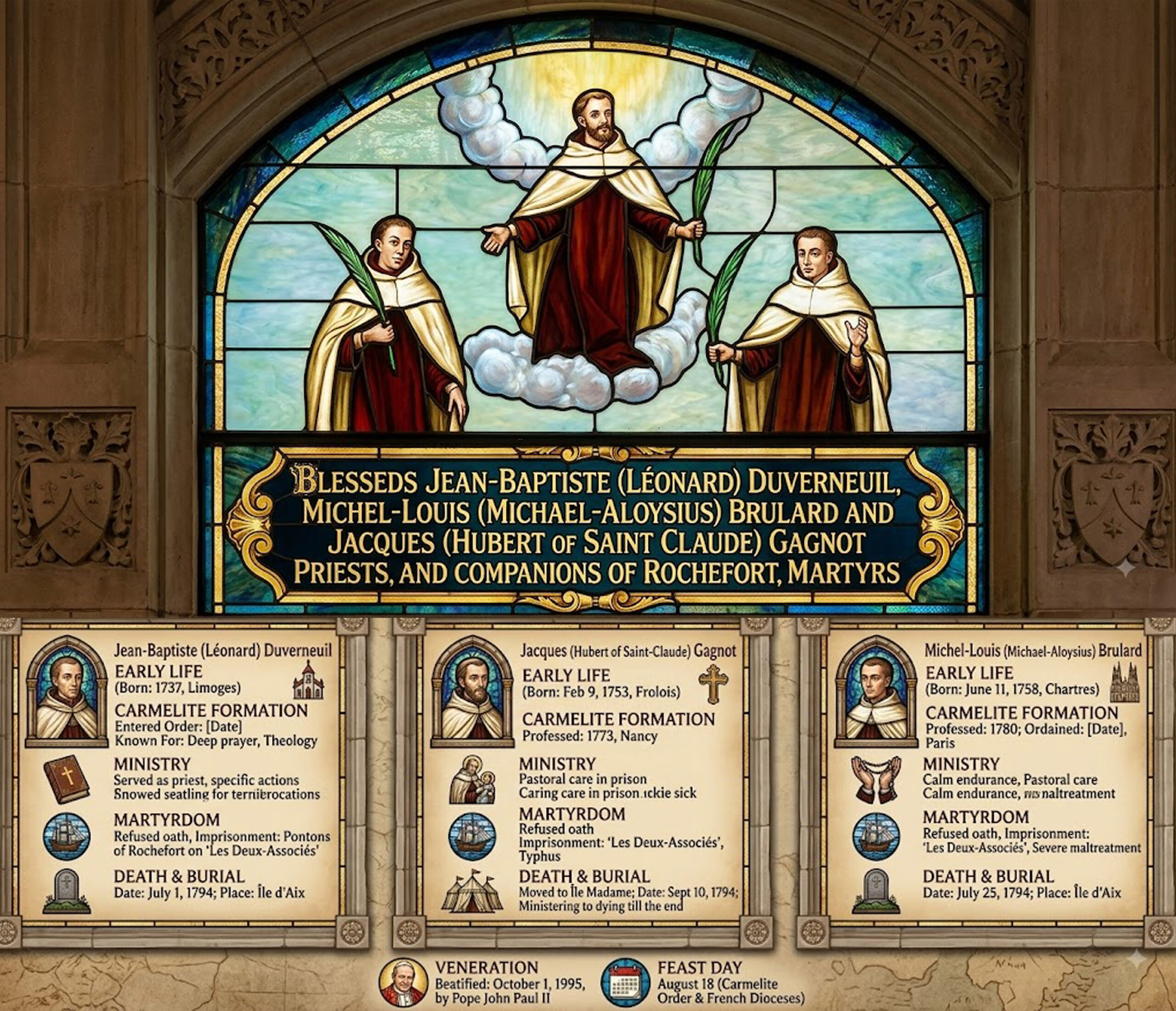
AUGUST 18 – BLESSEDS LEONARD DUVERNEUIL, MICHAEL-ALOYSIUS BRULARD AND HUBERT OF SAINT CLAUDE GAGNOT

Carmelite Memorial (OCD) – August 18
BLESSEDS LEONARD DUVERNEUIL, MICHAEL-ALOYSIUS BRULARD AND HUBERT OF SAINT CLAUDE GAGNOT
Priests, and Companions of Rochefort, Martyrs

Fr. Leonard Duverneuil (b. 1737 at Limoges), Fr. Michael-Aloysius Brulard (b. 1758 at Chartres), and Fr. Hubert of Saint Claude Gagnot (b. 1753 at Frolois), were among a group of 64 Martyrs beatified 1st October 1995, victims of the French Revolution who came from 14 French dioceses and from various religious Orders. In their loyalty to God, the Church and the Pope, they refused to take the oath of the Civil Constitution for the Clergy imposed by the Constituent Assembly of the Revolution. As a result, they were imprisoned, massed like animals, on a slave-trader ship in Rochefort Bay, waiting in vain to be deported into slavery. During 1794, the first two Carmelites died on board ship: Fr. Leonard on 1st July, and Fr. Michael-Aloysius on 25th July, both being buried on the island of Aix. After the plague broke out on the ship, those remaining disembarked on the island of Madame, where Fr. Hubert died and was buried on 10th September. Noted for their loving ministry to their fellow prisoners and their patience in accepting every type of outrage, privation, and cruelty, not to mention the vicissitudes of weather, hunger and sickness, our three Discalced Carmelite priest martyrs and their companions in martyrdom gave unsurpassed Christian witness to their faith and love.

AUGUST 17

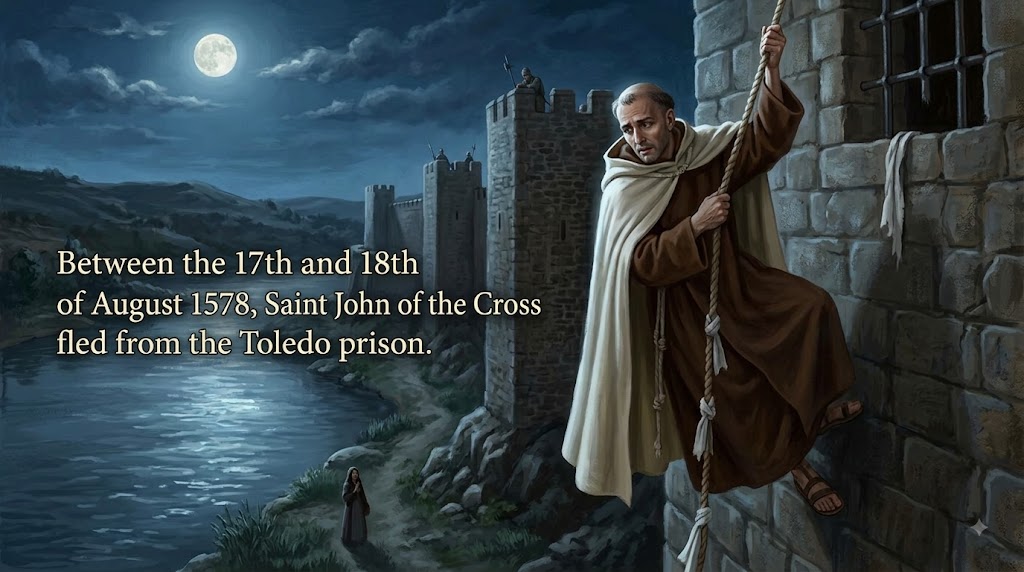
On which night did Saint John of the Cross escape from his prison cell in Toledo?

Scholars differ, but one night during the Octave of the Assumption is the safest guess. Some propose the night of August 17th or 18th as the most likely date. Kieran Kavanaugh, OCD writes:

Taking advantage of a new jailer who was kinder and more lenient, John managed to get paper and ink so as to write down his poems. He also had the opportunity, during a daily reprieve from his cell, to familiarize himself with the monastery surroundings. Then, one hot night in August, after being held prisoner for nine months, emaciated and close to death, John chose life and undertook a dangerous escape he had plotted during the short periods out of his cell. He had discovered a window that looked down on the Tajo river, and underneath the window was the top of a wall. But, of course, there was a lock on his prison door. He solved that problem by loosening the screws of the lock while his jailer was absent. When the friars seemed to be asleep and the house all still, he pushed hard on the door of his prison and the lock came loose. This enabled him to leave his prison and find his way in the dark to the window. By means of a kind of rope made out of strips torn from two old bed covers and attached to a lamp hook, he escaped through the window onto the top of the wall. The wall encircled the monastery and its garden, so he walked around the top of it until he came to what he thought was the street side. There he jumped from the wall, only to find himself in another bad predicament. He had landed inside the courtyard of the Franciscan nuns of the Conception monastery that was adjacent to that of the Carmelites. Fortunately, in one corner of the nuns’ garden he found that the stones in the wall could be used as steps, allowing him to climb over the wall to the city street and to his freedom. Some claimed his escape was miraculous.

The new jailer, Fray John of Saint Mary, later gave this testimony concerning the daring escape:

The servant of God took the handle of an oil lamp and wedged it between the timber and the brick. Tearing some old blankets into strips, he tied one strip to the lamp handle, fastened the others end to end, and added an old tunic—or part of one—at the bottom. Even then, his makeshift rope ended about ten feet above the ground. Worse still, it hung over such a dangerous spot that, unless he dropped straight down, or if he slipped, he would plunge over a precipice. The recent construction had left everything in disarray.

Historian Peter Thomas Rohrbach, OCD continues the story:

On the other side of the monastery wall that August night in 1578, John was lost in the unfamiliar city of Toledo. He slept the rest of the night in a hallway, and in the early morning asked directions to the convent of Discalced nuns in the city from a startled passerby. Presenting himself at the convent, disheveled, almost collapsing from fatigue, he said to the nun behind the grille: “Daughter, I am Father John of the Cross, and I escaped from prison last night. Tell the mother prioress.” Anne of the Angels, the prioress, cleverly contrived to have him admitted into the nun’s cloister for the purpose of hearing the confession of a sick nun. A few minutes after she had brought him into the cloister a group of Calced friars arrived at the convent, demanding to know if their escaped prisoner were hiding on the premises. “It would be a miracle if you were to see any friar here,” she slyly answered. Nevertheless they searched the church and the parlors, and they apparently mistrusted the prioress, for they commissioned constables to patrol the area all day. In the evening the prioress called upon a friend of hers, Peter Gonzalez de Mendoza, a canon of the cathedral and administrator of the hospital of Holy Cross, who spirited John away from the convent, hiding him in his carriage. He brought the saint, who was now disguised in a black cassock, to his hospital where he secretly took care of him for two months until he was strong enough to travel.