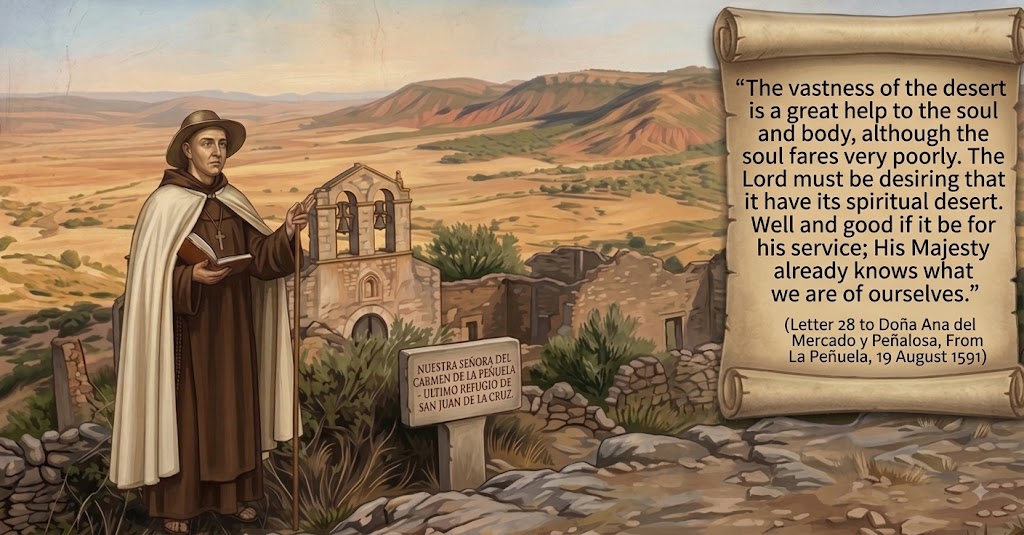
On 10 August 1591 – Saint John of the Cross transferred from the friars’ convent in Segovia to the solitude of La Peñuela, where at last he was relieved of all offices in the order; once again he was a humble friar, forgotten, despised, and neglected… as he had always desired.
His superior was the Provincial, Father Antonio de Jesús, with whom he had begun the reform under the guidance of Saint Teresa many years earlier in their humble abode in Duruelo.
Although John was able to pray gloriously in the solitude of rocks and forest, difficulties lay ahead; within weeks he would develop erysipelas, a skin infection on his foot that would lead to septicemia. By December, consumed by penances, trials, and his disease, Saint John of the Cross would die and go to “sing Matins in heaven.”
St. John of the Cross writes from La Peñuela about finding peace in solitude after being relieved of all offices. He delights in simple monastic work and the silence of harvesting chickpeas over worldly complications, asking prayers to remain in this blessed desert retreat.
———————————————————————————————-
“Faith,” St. Paul says, “is the substance of things to be hoped for, the evidence of things not seen” [Heb 11:1].
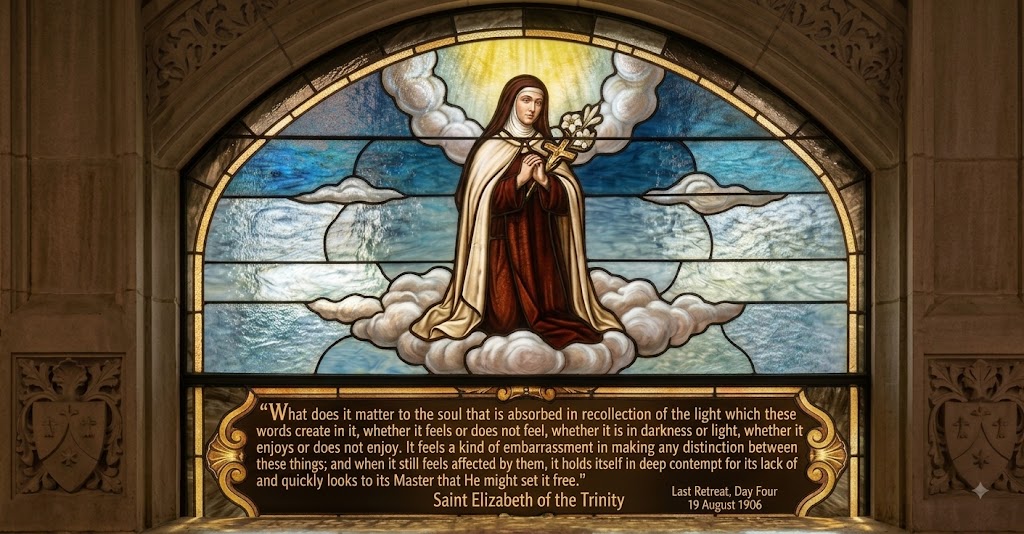
What does it matter to the soul that is absorbed in recollection of the light which these words create in it, whether it feels or does not feel, whether it is in darkness or light, whether it enjoys or does not enjoy. It feels a kind of embarrassment in making any distinction between these things; and when it still feels affected by them, it holds itself in deep contempt for its lack of love and quickly looks to its Master that He might set it free. In the expression of a great mystic it “exalts” Him “on the highest summit of the mountain of its heart, above the sweetness and consolations that descend from Him for it has resolved to go beyond everything to be united with Him whom it loves” [Ruysbroeck]. It seems to me that to this soul, unshakable in its faith in the God of Love, may be addressed these words of the Prince of Apostles, “Because you believe you will be filled with an unshakable and glorified joy” [1 Pt 1:8].
Saint Elizabeth of the Trinity
Last Retreat, Day Four
Sunday, 19 August 1906
———————————————————————————————-
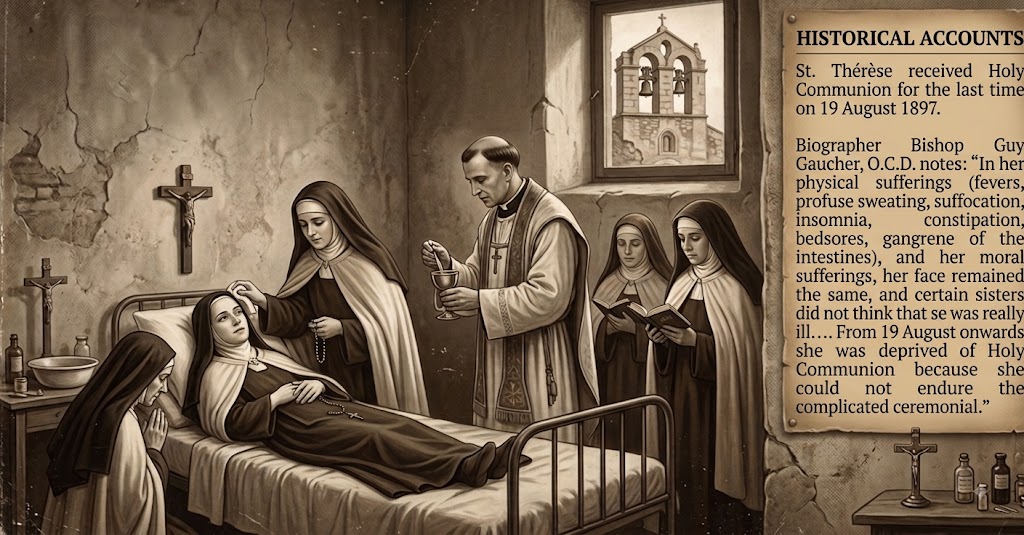
She must have felt bad before Holy Communion when hearing the Sisters reciting the Miserere in a low tone of voice. She told me afterwards, shedding huge tears:
“I’m perhaps losing my wits. Oh! If they only knew the weakness I’m experiencing.
“Last night, I couldn’t take anymore; I begged the Blessed Virgin to hold my head in her hands so that I could take my sufferings.”
Saint Thérèse of Lisieux
Yellow Notebook, 19 August 1897
Note: St. Thérèse received Holy Communion for the last time on 19 August 1897.
Biographer Bishop Guy Gaucher, O.C.D. notes:
In her physical sufferings (fevers, profuse sweating, suffocation, insomnia, constipation, bedsores, gangrene of the intestines), and her moral sufferings, her face remained the same, and certain sisters did not think that she was really ill…. From 19 August onwards she was deprived of Holy Communion because she could not endure the complicated ceremonial.
———————————————————————————————-