

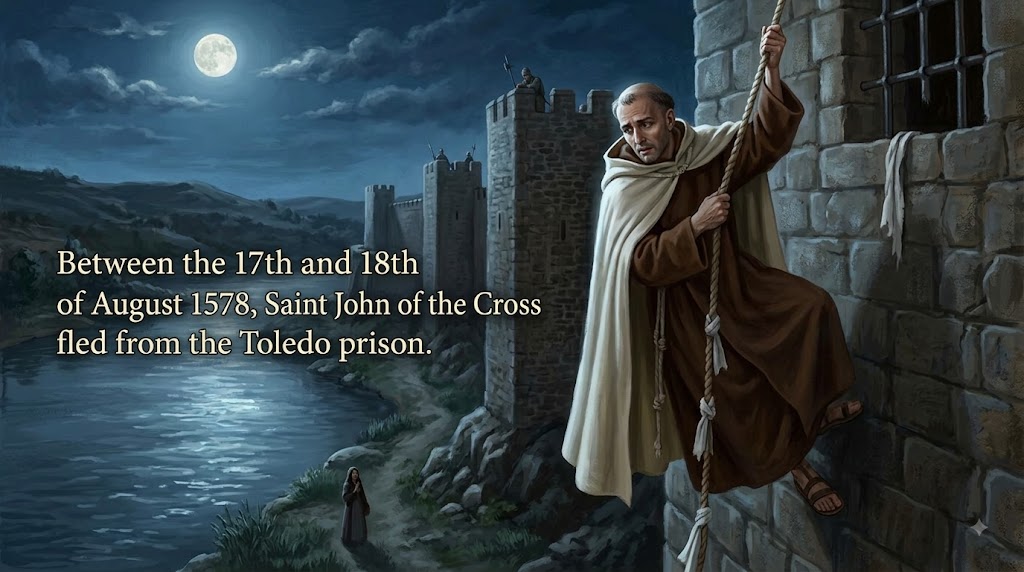
On which night did Saint John of the Cross escape from his prison cell in Toledo?
Scholars differ, but one night during the Octave of the Assumption is the safest guess. Some propose the night of August 17th or 18th as the most likely date. Kieran Kavanaugh, OCD writes:
Taking advantage of a new jailer who was kinder and more lenient, John managed to get paper and ink so as to write down his poems. He also had the opportunity, during a daily reprieve from his cell, to familiarize himself with the monastery surroundings. Then, one hot night in August, after being held prisoner for nine months, emaciated and close to death, John chose life and undertook a dangerous escape he had plotted during the short periods out of his cell. He had discovered a window that looked down on the Tajo river, and underneath the window was the top of a wall. But, of course, there was a lock on his prison door. He solved that problem by loosening the screws of the lock while his jailer was absent. When the friars seemed to be asleep and the house all still, he pushed hard on the door of his prison and the lock came loose. This enabled him to leave his prison and find his way in the dark to the window. By means of a kind of rope made out of strips torn from two old bed covers and attached to a lamp hook, he escaped through the window onto the top of the wall. The wall encircled the monastery and its garden, so he walked around the top of it until he came to what he thought was the street side. There he jumped from the wall, only to find himself in another bad predicament. He had landed inside the courtyard of the Franciscan nuns of the Conception monastery that was adjacent to that of the Carmelites. Fortunately, in one corner of the nuns’ garden he found that the stones in the wall could be used as steps, allowing him to climb over the wall to the city street and to his freedom. Some claimed his escape was miraculous.
The new jailer, Fray John of Saint Mary, later gave this testimony concerning the daring escape:
The servant of God took the handle of an oil lamp and wedged it between the timber and the brick. Tearing some old blankets into strips, he tied one strip to the lamp handle, fastened the others end to end, and added an old tunic—or part of one—at the bottom. Even then, his makeshift rope ended about ten feet above the ground. Worse still, it hung over such a dangerous spot that, unless he dropped straight down, or if he slipped, he would plunge over a precipice. The recent construction had left everything in disarray.
Historian Peter Thomas Rohrbach, OCD continues the story:
On the other side of the monastery wall that August night in 1578, John was lost in the unfamiliar city of Toledo. He slept the rest of the night in a hallway, and in the early morning asked directions to the convent of Discalced nuns in the city from a startled passerby. Presenting himself at the convent, disheveled, almost collapsing from fatigue, he said to the nun behind the grille: “Daughter, I am Father John of the Cross, and I escaped from prison last night. Tell the mother prioress.” Anne of the Angels, the prioress, cleverly contrived to have him admitted into the nun’s cloister for the purpose of hearing the confession of a sick nun. A few minutes after she had brought him into the cloister a group of Calced friars arrived at the convent, demanding to know if their escaped prisoner were hiding on the premises. “It would be a miracle if you were to see any friar here,” she slyly answered. Nevertheless they searched the church and the parlors, and they apparently mistrusted the prioress, for they commissioned constables to patrol the area all day. In the evening the prioress called upon a friend of hers, Peter Gonzalez de Mendoza, a canon of the cathedral and administrator of the hospital of Holy Cross, who spirited John away from the convent, hiding him in his carriage. He brought the saint, who was now disguised in a black cassock, to his hospital where he secretly took care of him for two months until he was strong enough to travel.