The Mantuan Reform (formally the Congregatio Mantuana) represents one of the earliest and most influential internal renewals within the Carmelite Order, pre-dating the Discalced Carmelite reform of Saint Teresa of Ávila. Emerging in northern Italy, it sought to recover the contemplative rigour, poverty, and communal discipline that had eroded across Western monasticism in the wake of the Black Death and the Western Schism.
By the late 1300s, the Carmelite Order had widely adopted mitigations to its original Primitive Rule. The devastation of the Black Death, economic instability, and papal dispensations (Pope Eugene IV’s mitigation of 1432) had relaxed practices around strict cloister, fasting, silence, and individual poverty.
In the late 14th century, with friars such as Blessed Angelo Mazzinghi, the Convent of Santa Maria della Selva, in Florence, pushed for stricter observance of common life and personal poverty. The Convent of San Marco in Mantua, under the patronage of the ruling Gonzaga family became the intellectual and spiritual nucleus for friars desiring a return to early Carmelite austerity.
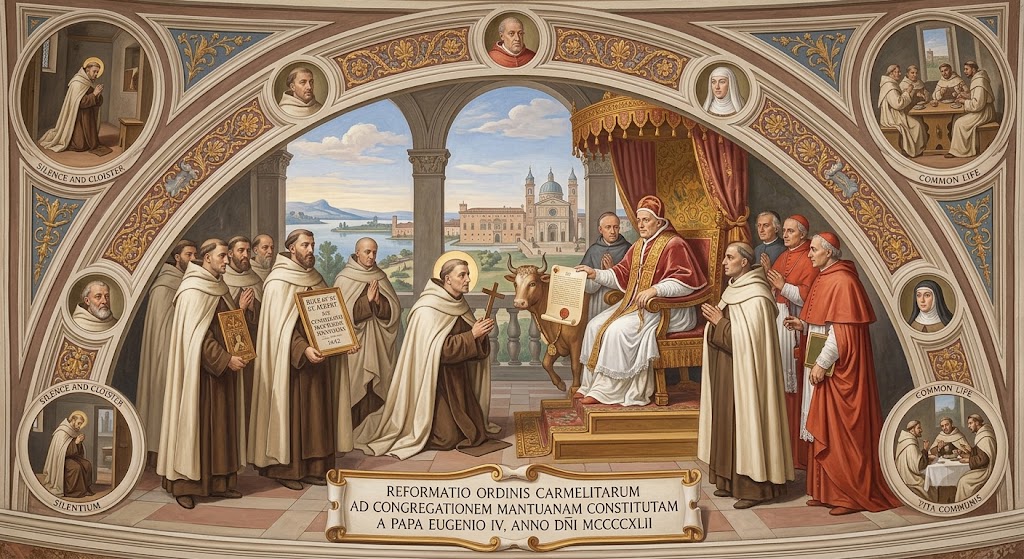
The movement gained autonomous status On 3rd September 1442, when Pope Eugene IV, by his Bull “Fama Laudabilis,” approved the reform of the Carmelite Order into what became known as the Mantuan Congregation. To protect the fledgling reform from interference by less observant regional Carmelite superiors, the bull granted the Mantuan friars significant structural autonomy. They were granted the right to elect their own Vicar General, who answered directly to the Prior General of the Order rather than to local Carmelite provincial priors. The houses within the Congregation were bound to common ownership; friars surrendered private stipends, gifts, and personal holdings, returning to the mendicant ideal of living strictly off common alms and shared provision.
By 1780, the Mantuan Congregation comprised 51 friaries and 15 convents.